
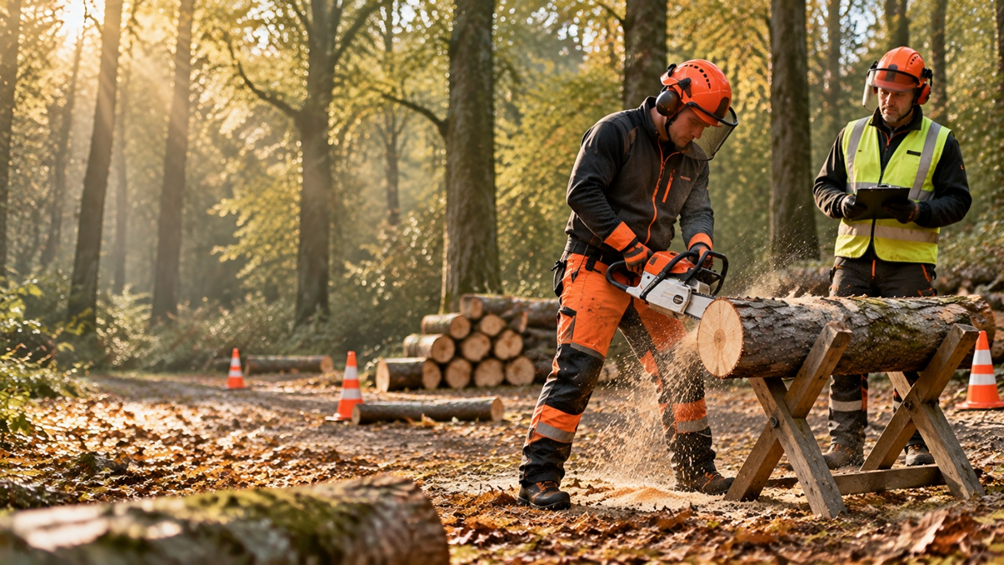
You do not need a licence to buy or use a chainsaw at home in the UK, because no chainsaw licence exists. If you use a chainsaw for work, you need adequate training and proof that you are competent. In practice, that means a Level 2 City & Guilds NPTC or Lantra Awards qualification: complete an accredited course, then pass an assessment.
Brampton Valley Training, a City & Guilds NPTC and Lantra approved centre in Towcester, Northamptonshire, trains people through exactly this route. This guide explains each step in plain language, so you know what to book, what to bring and what to expect on assessment day.
Quick Facts: Chainsaw Qualifications at a Glance
| Question | Short answer |
| Is there a chainsaw licence? | No. There is a certificate of competence instead. |
| Minimum age on courses | 16. |
| Starting qualification | Level 2 Chainsaw Maintenance and Cross-Cutting (formerly CS30). |
| Typical fees | About £470 to £490 for the first unit. About £755 for the first two units together. About £720 for Level 3 felling over 380mm. |
| Training length | 2 to 5 days, depending on the units and the centre. |
| Refresher training | Every 2 to 3 years for occasional users. Every 5 years for full-time users. |
| Why it matters | HSE reports 5 deaths from direct chainsaw contact in forestry and arboriculture in recent years, plus many serious injuries. |
Fees are based on course listings from UK colleges and training centres, checked in October 2026. Prices change, so always ask for a written quote.
Do You Need a Chainsaw Licence in the UK?
No single mandatory licence exists for owning or using a chainsaw. What exists is a set of rules in three layers, and each layer asks for something slightly different.
Layer 1: The Law
Three pieces of legislation sit behind chainsaw training.
- The Health and Safety at Work etc. Act 1974 puts general duties on employers and the self-employed.
- The Provision and Use of Work Equipment Regulations 1998 (PUWER) require people who use work equipment to be trained and competent.
- The Management of Health and Safety at Work Regulations 1999 require employers to provide health and safety training.
HSE’s chainsaw operator guidance says anyone who uses a chainsaw at work should have adequate training and be competent for the type of work. It also says operators must wear suitable protective clothing.
Layer 2: HSE Guidance on Certificates
HSE’s free leaflet Chainsaws at work (INDG317) goes further for tree work. Before using a chainsaw on or in a tree, a worker should hold a relevant certificate of competence or national competence award. The exception is someone who is in training and properly supervised.
The leaflet says “should”, not “must”. Some people treat that as a loophole, but it is not a safe one. The wording sits inside an approved code of practice. After an accident, an investigator will ask what evidence of training you had.
There is a narrow exception for farm work. It covers agricultural jobs such as hedging or clearing fallen branches. The work must be done by the occupier or their employees, and only by people who used a chainsaw before 5 December 1998. It does not cover tree surgery, and it does not cover anyone who started recently.
Layer 3: Insurers and Clients
This layer is the one that bites first in real life.
- Councils tell householders to check certificates. Sheffield City Council advises that anyone paid to work on trees with a chainsaw without training is breaking the law and may invalidate their insurance.
- Local authorities expect proof. Coventry City Council’s guidance on choosing an arborist says contractors should show NPTC certificates for chainsaw use, along with insurance.
- Policies can carry conditions. Public liability cover can exclude chainsaw work or require a certificate. Read the wording before you rely on it.
Four Common Situations
- Homeowner cutting their own logs. No certificate is legally required. HSE’s PUWER guidance says the Regulations do not cover domestic work in a private household. Training is still sensible, because the machine is just as dangerous in a garden.
- Employee at a landscaping firm. The employer must provide the training. HSE’s training and certification page says it must happen in working hours and employees must not have to pay.
- Self-employed gardener adding tree work. You need a certificate for the units that match your work. Your insurer will almost certainly ask for it.
- Farm or estate worker clearing storm damage. Check whether the agricultural exception genuinely applies. If you are unsure, get certified.
Not sure which situation applies to you? If you live or work around Northamptonshire, the assessors at Brampton Valley Training can help you match your tasks to the right units before you book anything.
Warning: Cutting a tree down is a separate question from using a saw. Many trees are protected by Tree Preservation Orders or stand in conservation areas. Check with your local council first. GOV.UK explains the rules on tree preservation orders.
Step 1: Identify the Right Level and Units
Chainsaw qualifications are modular. Each unit covers a set of tasks, and you pick the units that match your work and the size of the timber.
The old “CS” codes are still what most people search for. This table puts the old and current names side by side.
| Old code | Current name | Unit | What it covers | Prerequisite |
| CS30 | Level 2 Award in Chainsaw Maintenance and Cross-Cutting | 201 and 202 | PPE, maintenance, sharpening, safe starting, cross-cutting on the ground. | None. |
| CS31 | Level 2 Award in Felling and Processing Trees up to 380mm | 203 | Felling small trees, removing branches, taking down hung-up trees. | CS30. |
| CS32 | Level 3 Award in Felling and Processing Trees over 380mm | 301 | Felling medium and large trees. | Level 2 units. |
| CS38 | Level 2 Award in Tree Climbing and Rescue | Not applicable. | Climbing and aerial rescue. | Centre-specific. |
| CS39 | Level 3 Award in Aerial Cutting of Trees with a Chainsaw Using Free-fall Techniques | Not applicable. | Cutting from a rope and harness. | Centre-specific. |
HSE confirms that certificates gained before September 2012 are unaffected and remain valid. See its guidance on changes to chainsaw training.
Which Unit Do You Actually Need?
Match the job, not the course title.
| Your task | Minimum units |
| Cutting fallen logs for firewood. | CS30. |
| Clearing branches after a storm, on the ground. | CS30. |
| Felling a small tree up to 380mm across. | CS30 and CS31. |
| Felling a tree wider than 380mm. | CS30, CS31 and Level 3 felling. |
| Cutting windblown or damaged trees. | Level 3 specialist units. |
| Working in a tree on a rope and harness. | Ground units, plus climbing and aerial units. |
The 380mm figure is the diameter of the tree at felling height. It has nothing to do with the length of your saw bar. This is a common mistake, so it is worth knowing early.
Quick Self-Check
Answer yes or no to each question.
- Will I use the saw for paid work?
- Will I cut anything that is still standing?
- Is any trunk wider than 380mm?
- Will I work above ground?
- Do I already hold an older certificate?
Here is how to read your answers.
- Yes to question 1: You need a certificate.
- Yes to question 2: You need the felling unit as well as maintenance and cross-cutting.
- Yes to question 3 or 4: You need Level 3 or aerial units.
- Yes to question 5: Check whether it is still valid and whether a refresher is due.
Step 2: Choose the Training Route
Training is delivered by accredited centres. The two awarding bodies you will see are City & Guilds NPTC and Lantra Awards. The centres themselves include agricultural colleges, private training providers and forestry academies.
What to Look for in a Chainsaw Training Centre in Northamptonshire
Use this checklist when you compare centres.
- Approvals. The centre should be named as a City & Guilds NPTC approved centre, a Lantra approved centre, or both.
- Independent assessment. Ask who assesses you and when. This matters if you will work for money.
- A written kit list. You should receive it before the course starts.
- Clear fees. Ask what the price includes, particularly registration and assessment.
- A re-test policy. Ask what happens, and what it costs, if you do not pass first time.
- Location. A centre close to home saves travel costs and tired driving after long training days.
- Practical focus. Courses should be hands-on, not mostly classroom slides.
Brampton Valley Training is based at York’s Farm Business Centre in Towcester and displays City & Guilds NPTC, Lantra, Arb Approved Contractor, SafeContractor and TrustMark accreditations on its website. That is the kind of evidence you should expect from any centre you consider.
Integrated or Independent Assessment
This is the part most guides skip, and it affects what you can do with the certificate afterwards.
| City & Guilds NPTC route | Lantra integrated route | |
| Who assesses | An independent assessor, separate from your trainer. | Your trainer, during the course. |
| When | Usually after the training days. | During the training days. |
| Suited to | Professional use and higher-risk work. | Occasional and lower-risk use. |
| Worth knowing | The standard route for tree work. | Covers petrol and battery saws on Lantra’s maintenance and cross-cutting course. |
Since 2012, HSE’s guidance has treated activities differently according to risk. Lantra’s own course page says its integrated course is not suitable for professional chainsaw users. The industry recommendation for high-risk work is a certificate where assessment is carried out independently of the training.
The simple rule: if you will work for money, choose the independently assessed route. If you are a landowner or occasional user, the integrated route can be a reasonable and cheaper fit.
Red Flags When Choosing a Provider
- The course is online only and promises a “chainsaw licence”.
- No awarding body is named.
- The certificate carries no City & Guilds or Lantra branding.
- You get vague answers about re-test fees.
- No kit list arrives before the course.
What Happens on the Training Days
Courses mix classroom theory with hands-on practice. Expect to be on your feet outdoors for most of each day.
CS30 training covers:
- The safety features of the saw and the law behind them.
- Protective equipment and how to check it.
- Fuel, chain oil and pre-use checks.
- Sharpening and maintaining the chain.
- Safe starting, hot and cold.
- Cross-cutting timber, including wood under tension and compression.
CS31 training adds:
- Judging a tree for size, weight, species and weather before you cut.
- Planning the felling direction and an escape route.
- Making the felling cuts.
- Removing branches from the felled tree.
- Taking down a hung-up tree safely.
Centres note that a minimum level of fitness is needed. Bring a personal first aid kit if your centre asks for one. Tell your trainer about any medication that could affect how you work.
Step 3: Complete the Independent Assessment
Finishing the training days does not automatically award the qualification on the NPTC route. You must also pass an assessment.
How the Assessment Works
- Registration comes first. NPTC’s assessment schedule says you must be registered through an approved assessment centre before you are assessed.
- Only approved assessors can assess you. They must be approved by City & Guilds for that scheme.
- There are two parts. One tests knowledge and understanding. The other tests your practical skills.
- Safety applies throughout. The saw must be operated safely at all times. The schedule also requires a risk assessment and a spare working chainsaw.
- Timing varies. Some centres assess on the day after training. Others assess a week later. Ask for the date when you book.
What Assessors Look For
- A proper pre-use check of the saw and your protective kit.
- Chain sharpening and maintenance to the standard in the schedule.
- Safe starting, a correct cutting position and chain brake use between cuts.
- Correct felling cuts, a clear escape route and awareness of the work area.
- Spoken answers on safety, legislation and risk assessment.
Why People Fail
These points come from candidates’ own accounts on the trade forum ArbTalk. Treat them as practical colour, not official criteria.
- Arriving with a worn chain that has little life left for the sharpening task.
- Cutting a back cut at the wrong angle, often when tired late in the day.
- Cutting inside the kickback zone.
- Forgetting to apply the chain brake when moving.
- Knowing the practical skills but not the theory behind them.
Ask your centre what happens if you are not ready, and what a re-test costs. Some centres do not include re-tests in the course fee.
Seven Days Before Your Assessment
- Read the assessment schedule for your unit from start to finish.
- Practise explaining each safety feature out loud.
- Sharpen your chain and check how much life it has left.
- Check that your PPE is in date and carries the correct marks.
- Re-read the risk assessment steps.
- Sleep properly the night before.
- Eat before you go, because the day is physical.
PPE: Standards and What to Buy Before You Book
Most centres expect you to bring your own protective clothing. Some also expect you to bring the saw. Policies differ, so get the kit list in writing before you spend any money.
HSE’s chainsaw PPE page sets out the standards. Centres often add rules of their own.
| Item | Standard | What to check with your centre |
| Helmet | BS EN 397, BS EN 14052 or BS EN 12492. | Whether there is a maximum helmet age. |
| Mesh visor | BS EN 1731. | Whether it is built into the helmet. |
| Ear defenders | BS EN 352. | Whether they fit your helmet. |
| Gloves | BS EN 381-7. | Left-hand protection is standard. |
| Boots | Chainsaw boots with protective guarding at the front. | Whether gaiters or spats are accepted. |
| Trousers | Type A as a minimum for ground work. Type C for climbing. | Whether chaps are accepted. |
| Hi-vis top | Not applicable. | Short sleeves are usually fine. |
HSE says gaiters to EN 381-9 can suit occasional users on even ground when worn over steel-toe boots. Even so, many centres will not accept them for a course. Bundled kits often include chaps, which are fine for home use but may be refused on a course.
Warning: Do not buy PPE until your centre confirms what it will accept. A kit that fails the checklist is money wasted.
What PPE Costs
Retailer listings checked in October 2026 showed Type A trousers from roughly £80 to just under £300, depending on brand and features. Chainsaw boots ranged from around £80 to well over £300, and helmet sets with a visor and ear defenders started at around £100. A realistic entry budget is a few hundred pounds. Climbing kit costs more.
How Much Does a Chainsaw Qualification Cost?
Fees vary by centre, region and what is included. Some fees cover registration and assessment. Others do not, and re-tests are usually extra.
Typical Fees
| Course | Typical fee |
| CS30 (maintenance and cross-cutting). | About £470 to £490. |
| CS30 and CS31 together. | About £755. |
| Level 3 felling over 380mm. | About £720. |
| Lantra refresher for CS30 and CS31. | About £400. |
Worked Examples
These examples use a placeholder PPE budget of £370. It is built from assumed prices of £115 for trousers, £125 for boots, £100 for a helmet, visor and ear defender set, and £30 for gloves. Swap in your own quotes.
Example 1: A homeowner who cuts firewood
- CS30 course: £490.
- PPE: £370.
- Travel: £60 (assumed).
- Total: £920.
Example 2: A new landscaper
- CS30 and CS31: £755.
- PPE: £370.
- Total: £1,125. If the employer pays the course fee, as they should, your cost drops to £370.
Example 3: Someone building a tree-work career
- CS30 and CS31: £755.
- Level 3 felling: £720.
- PPE: £370.
- Subtotal: £1,845.
- Add a refresher at £400 after five years: £2,245.
Some learners can get help with fees. Some centres mention Forestry Training Grants for eligible applicants, so ask before you pay.
How Long Does It Take?
A realistic timeline for your first qualification looks like this.
- Week 1: Decide which units you need and request kit lists from two or three centres.
- Weeks 2 to 6: Book a course date. Places fill quickly, especially in autumn.
- Course week: Complete training, then assessment on the day after or the following week.
- Following days or weeks: Receive your results and certificate.
Plan on four to eight weeks from first enquiry to qualification.
After You Pass: Proof and Refresher Training
Your Certificate
You receive a nationally recognised certificate of competence. City & Guilds no longer produces a physical skills card after successful completion. Some Lantra routes may offer a card with registration fees, so ask your centre.
Keep a digital copy and a printed copy. Clients and insurers will ask to see it, often at short notice.
Refresher Training
The certificate has no legal expiry date. However, HSE’s INDG317 recommends refresher training at these intervals:
- Every 2 to 3 years for occasional users.
- Every 5 years for full-time users.
If your last course was more than five years ago, book a refresher. An insurer or investigator will treat a lapsed certificate as a weak defence.
Beyond Level 2: Specialist Courses at Brampton Valley Training
Many people start with ground-based chainsaw units, then add specialist courses as their work grows. The Brampton Valley Training course library is organised into six categories:
- Ground-based chainsaw.
- Aerial.
- Utility arboriculture.
- Land-based machinery.
- Health and safety.
- Pesticides.
Level 3 units cover trees over 380mm, windblown or storm-damaged timber, assisted felling, climbing and aerial cutting. You will usually need the lower-level ground certificates first, and higher units demand more fitness.
Which Route Fits You?
| If you are a… | Start with | Then consider |
| Homeowner or smallholder. | CS30. | CS31 if you fell small trees. |
| Farm or estate worker. | CS30 and CS31. | Level 3 felling for larger timber. |
| Landscaper or groundsperson. | CS30 and CS31. | Chipper and machinery courses. |
| Aspiring tree surgeon. | CS30 and CS31. | Climbing, aerial cutting and rescue. |
| Utility or highways contractor. | Ground-based units. | Utility arboriculture units. |
Chainsaw Myths and Facts
| Myth | Fact |
| “I need a licence to own a chainsaw.” | No chainsaw licence exists. Certificates relate to competence at work. |
| “A certificate lets me fell any tree.” | Units limit tree size and task type. Many trees also need council permission. |
| “My old certificate never runs out.” | It has no legal expiry date, but HSE recommends refreshers. |
| “An online course is enough.” | The practical skills and assessment must be completed in person. |
| “Training is the employee’s cost.” | HSE says employers must provide it in working hours at no cost to employees. |
Frequently Asked Questions
Do I need a licence to use a chainsaw in the UK?
No. No chainsaw licence exists. If you use one for work, you need training and proof of competence.
Do you need a qualification to use a chainsaw at home?
Not by law for private household work. Training is still strongly advised, and some insurers expect it.
How long does a chainsaw certificate last?
There is no legal expiry date. HSE recommends refresher training every 2 to 3 years for occasional users and every 5 years for full-time users.
How much does a chainsaw course cost in the UK?
A first course usually costs about £470 to £490. The first two units together cost about £755. PPE and travel are extra.
What is the difference between CS30 and CS31?
CS30 covers chainsaw maintenance and cross-cutting. CS31 covers felling trees up to 380mm and builds on CS30.
Can you get a chainsaw qualification online?
No. The practical cutting and the assessment must be completed in person.
What age can you use a chainsaw?
Training centres set the minimum age for courses at 16.
What PPE do you need for a chainsaw course?
You need a helmet with a visor and ear defenders, chainsaw gloves, chainsaw boots and chainsaw trousers. Confirm the exact kit list with your centre first.
Do you need insurance to use a chainsaw?
Insurance is not a legal requirement for private use. For paid work, clients usually expect public liability cover, and employers must hold employers’ liability cover if they have staff.
Final Checklist: Your Route to a Chainsaw Qualification
- Decide whether your work needs a certificate.
- Match your tasks to the right units.
- Choose an independent or integrated assessment route that fits your work.
- Request the kit list before you buy PPE.
- Confirm what the fee includes, especially assessment and re-tests.
- Practise the maintenance tasks and learn the safety theory.
- Keep a digital and printed copy of your certificate.
- Diarise your refresher date.
Book Chainsaw Training in Towcester, Northamptonshire
Ready to get qualified? Contact the team at Brampton Valley Training, Unit 10, York’s Farm Business Centre, Towcester, NN12 8EU, or call 01327 831299. Ask for a written quote that includes registration, assessment and re-test terms, plus the kit list for your course.


Leave a reply